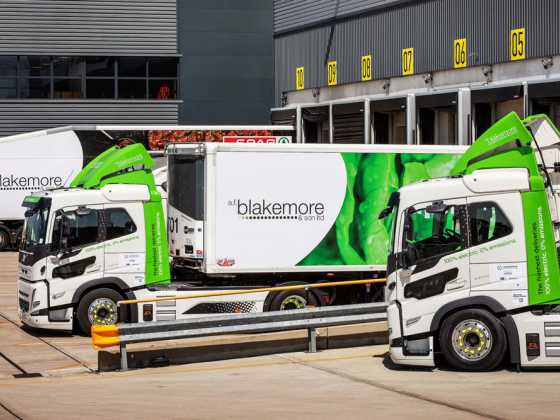
Clear roadmap is essential for decarbonising UK logistics
Feature

Lamech Solomon, head of decarbonisation policy at Logistics UK, ponders the challenge of decarbonising road logistics
Low confidence across the logistics sector and insufficient support means government decarbonisation targets are at significant risk of being missed. The stark warning is revealed in a comprehensive report from Logistics UK that was published last month: “Powering Change: building a credible plan for decarbonising road logistics”. The data-led policy report draws on the expertise of our members and wider industry and reveals a growing gap between decarbonisation targets and industry readiness - particularly from smaller operators who form the backbone of the industry.
The urgent need to reduce emissions and address climate change is not in question: the sector is committed to decarbonising and across the sector we see investment in infrastructure, adoption of battery electric vehicles, large-scale trials of battery HGVs and greater use of low carbon fuel. The report also highlights the resilience and determination of the industry to meet the need for low-emission logistics: diesel use is predicted to drop to 50% by 2030 from current use of 80% through increased use of low carbon fuel, as well as a rise in battery electric vehicles.
Yet there is no avoiding the reality that operators consider the current technology and policy landscape confusing and fragmented. The research outlined in the report, shows industry’s concerns are driven by a lack of confidence that there is sufficient support for the sector to switch to Zero Emission Vehicles: over 85% of survey respondents express low confidence in the availability of suitable public charging; more than 80% disagree they can install chargers with sufficient capacity at their operating sites; and around 60% feel there is insufficient guidance and funding.
The report also makes for sobering reading regarding phase-out of diesel vehicles and 80% of industry stakeholders, who contributed to Logistics UK’s research, are not confident the phase-out dates for diesel vans and Heavy Goods Vehicles (HGVs) will be met. The date to end the sale of internal combustion engine vehicles is now less than 10 years away for the lightest road freight vehicles, and under 15 for the heaviest. There is an urgent need to build confidence and accelerate progress and Logistics UK is calling for a pragmatic and cost-effective approach for logistics decarbonisation, shaped through a co-owned industry and cross-government roadmap.
Electrification will be central to decarbonising road freight but for an industry that operates on slim margins, the cost of the transition is currently considered prohibitive. We all have an incentive for the transition to be delivered economically: logistics costs are embedded in all products so how much it costs for the sector to decarbonise, and how it affects supply chains, will impact us all.
Road freight is critical to the UK’s way of life and 4.8 million Light Commercial Vehicles, and over half a million Heavy Goods Vehicles operate on UK roads, delivering essential goods for consumers and businesses across the UK and beyond. Road freight and its associated activities account for 18.4% of the £170 billion the logistics sector contributes each year to the UK economy, and 80% of UK freight travels on roads at some point on its journey to the end user. This is why it is so critical to strengthen trust and help the sector decarbonise is a pragmatic way and to achieve this there must be a clear, credible and shared plan.
Logistics UK’s report identifies government policy mechanisms such as prioritising grid connections at logistics hubs and ports, extending the ZEHID programme; targeted financial support for logistics operators; clear national guidance for managing the connection process supported by Distribution Network Operators (DNO) and scaling up use of low carbon fuel as key enablers to help the sector achieve its decarbonisation goals. Bringing together operators, energy providers, vehicle manufacturers and policymakers to develop a technology-neutral roadmap is essential. Such a roadmap would support coordinated investment and improved accountability across the system, providing the long-term certainty the sector needs to decarbonise.
Copies of the report can be downloaded here.