The need for stable government policy on fleet decarbonisation emerged as the dominant theme at GREENFLEET's first GF100 Summer Summit, where industry leaders, fleet operators and sustainability experts discussed the future of transport decarbonisation.
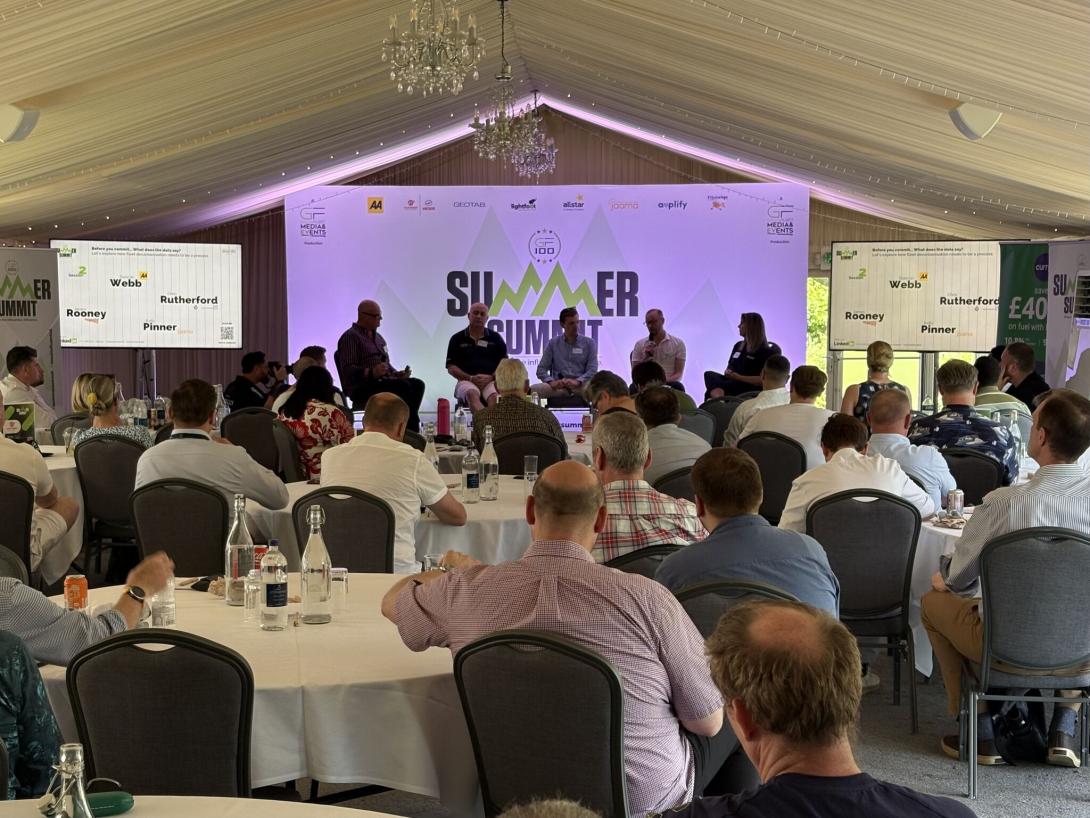
Following the publication of this year's GF100 Most Influential list in February, GREENFLEET hosted its inaugural GF100 Summer Summit on 24 June at Hunton Park Hotel in Watford.
The GF100 Most Influential recognises the outstanding individuals driving meaningful progress in fleet and transport decarbonisation. The Summer Summit brought many of these influential leaders together in person to collaborate, debate and help shape a collective strategy for the future of fleet decarbonisation.
Hosted by sustainability expert John Curtis, the event featured a series of panel discussions, audience Q&A sessions and interactive polling, creating an unusually candid environment where fleet operators, manufacturers, infrastructure providers, and other key stakeholders were able to debate both the successes and frustrations of the UK's transition to zero-emission transport.
Audience participation through live polling and Q&A ensured the conversations reflected the real-world challenges facing fleets, with a clear message emerging: fleet decarbonisation is difficult and while the fleet industry remains committed to decarbonisation, achieving it will require clear, stable and long-term government policy.
Policy certainty critical to fleet investment
The opening session explored the current state of fleet decarbonisation and the challenges that lie ahead, featuring Robert Evans, CEO of Cenex, Lamech Solomon, Head of Decarbonisation at Logistics UK, and Catherine Bowen, Head of Decarbonisation & Future Mobility at the BVRLA.
Robert Evans highlighted the importance of stable government policy, particularly amid ongoing discussions around potential changes to the Zero Emission Vehicle (ZEV) Mandate. He warned that uncertainty could have unintended consequences, with fleets potentially extending the use of diesel vehicles if confidence in future targets is weakened.
"The government sees the zero-emission targets as years away, but for a fleet that's only one or two replacement cycles," said Robert. "With the cost of transitioning so significant, businesses need confidence that the policy isn't going to change."
With fleets making investment decisions today that will impact their operations for years to come, policy stability is essential.
Lamech Solomon emphasised that while enthusiasm for decarbonisation remains strong among commercial vehicle operators, infrastructure development must keep pace. He noted that electric HGV adoption will struggle without a clear roadmap and adequate charging infrastructure.
"There's enthusiasm from commercial vehicle operators to decarbonise, but there's also concern that the push comes before the system is ready," he said.
Lamech also highlighted the role of alternative fuels such as HVO, noting that organisations can achieve significant emissions reductions where electrification is not yet practical.
Catherine Bowen focused on the challenges facing electric van adoption, particularly around charging infrastructure. Issues such as bay size, height restrictions and the realities of home charging continue to create barriers for operators.
"While we got a lot of what we asked for from our BVRLA Van Plan, we are still a long way away from mass electric van adoption," she said.
Catherine highlighted the challenges faced by SMEs, noting that many van drivers take vehicles home rather than returning to a depot, increasing reliance on public charging infrastructure if home charging isn't possible.
The panel also debated whether a zero-emission mandate for trucks would be effective at this stage, with the consensus suggesting that the market and supporting infrastructure are not yet sufficiently mature.
Data driving decarbonisation
The second session examined the growing importance of data in fleet management, featuring Chris Rutherford, Next Generation Ambulance Programme Lead at London Ambulance Service NHS Trust, Duncan Webb, Head of Fleet at The AA, James Rooney, Head of Road Fleet at Network Rail, and Kelly Pinner, Head of Business Development at Jaama.
Chris Rutherford discussed the introduction of the Trust's first electric ambulance, launched on New Year's Eve 2023. He explained how detailed operational data enabled analysts to model vehicle suitability, demonstrating that ambulances could be successfully recharged during the typical 45-minute turnaround between shifts.
Duncan Webb outlined how The AA balances decarbonisation goals with its core responsibility of helping stranded motorists. Vehicle suitability remains paramount, with challenges such as towing capability still influencing fleet decisions.
James Rooney shared how data has supported Network Rail's electrification strategy, with the organisation targeting 50 per cent of its fleet to be electric by 2027 despite operating a diverse range of vehicles and complex operations.
Electrification progress
The third session focused on how electrification is progressing across commercial fleets. Speakers included Sam Clarke, Head of eHGV at Gridserve, Stuart Murphy, Head of Fleet Transformation & Integration at Royal Mail, James Hooker, National Bus Sales Manager at Harris Bus and Coach, and Thomas Rowlands, Managing Director, Global EV Solutions at Allstar (Corpay).
Stuart Murphy described how fleet management now extends beyond vehicles to include estates, energy and charging infrastructure. Collaboration with property teams has become increasingly important as organisations roll out charging solutions.
While Royal Mail has successfully electrified many of its delivery vehicles, the organisation operates other vehicles, such as trucks, which present more complex challenges. He encouraged organisations to take a measured approach.
"You don't have to rush. You can look at the data and work with OEMs to tweak vehicles to ensure they are fit for purpose."
Stuart also welcomed recent government changes affecting electric vans. From 1 June 2026, zero-emission vans weighing between 3.5 and 4.25 tonnes moved from the HGV testing regime into the Class 7 MOT system, with the first MOT now required after three years rather than one. He noted that the changes make larger electric vans a more viable option while also reducing pressure on workshop capacity.
Sam Clarke highlighted the progress of the government's £200 million Electric Freightway project, which is deploying electric trucks and charging infrastructure across the UK. However, he stressed that accelerating grid upgrades remains a critical challenge and suggested additional government support could help speed up deployment.
Thomas Rowlands discussed how data can help organisations develop more efficient charging strategies that work for both drivers and businesses.
GF100 leaders reiterate need for consistency
The final session brought together the top three individuals from the 2025 GF100 Most Influential list: Paul Hollick, Chair of the Association of Fleet Professionals and CEO of Lightfoot; Lorna McAtear, Head of Fleet at National Grid; and Sara Sloman, Global Partnerships Director at Paythru.
Once again, the discussion returned to the importance of consistent government policy. The panel warned that uncertainty risks slowing investment and could leave the UK lagging behind other countries in the race to decarbonise transport.
Sara Sloman also urged the industry to simplify its messaging around decarbonisation, arguing that excessive jargon and acronyms can alienate the very audiences the sector needs to engage.
The panel additionally discussed the potential impact of Electric Vehicle Excise Duty (E-VED), expressing concerns that it could create further barriers to EV adoption.
Rising stars recognised
During the Summit, GREENFLEET hosted its inaugural GF100 Rising Star Awards, sponsored by The AA, celebrating emerging leaders who are making a positive impact within their organisations and across the wider fleet sector.
The 2025 winners were Rosario Surace of Drax Electric Vehicles, Lois Loxley of Zemo Partnership and Harry Chapman of Speedy Hire.
The Summit also allowed delegates to get expert advice from sponsors The AA, Geotab, Amplify, Lightfoot, EVjuiceNgo, Jaama, Harris Higer, and Allstar - a Corpay Company.
Audience polls reinforce industry concerns
Interactive audience polling throughout the day reinforced the themes discussed on stage. When attendees were asked to identify the biggest barrier to fleet decarbonisation, 37 per cent cited uncertain government policy, making it the single largest concern. Charging infrastructure followed closely at 35 per cent, while cost and budget constraints accounted for 14 per cent. Vehicle suitability and availability received nine per cent of responses, while only four per cent identified internal organisational resistance as the primary barrier.
The results echoed the sentiment expressed repeatedly by speakers throughout the Summit: while the industry remains committed to decarbonisation, progress depends on clear, consistent and long-term policy direction from government.
There was also cause for optimism. When asked what proportion of their fleet they realistically expected to be zero-emission by 2030, 39 per cent of attendees said they expected their fleets to be fully zero-emission. A further 28 per cent anticipated reaching between 51 and 75 per cent zero-emission vehicles. Just Nine per cent expected to achieve less than 25 per cent, likely reflecting the particular challenges faced by HGV operators.
Looking ahead
The inaugural GF100 Summer Summit demonstrated both the significant progress being made across the fleet sector and the determination of industry leaders to accelerate decarbonisation. Yet the consensus was clear - greater certainty from government on long-term decarbonisation policy is essential if organisations are to make the investments needed to deliver a successful zero emission transition.
The day concluded with a networking BBQ on the hotel lawn, giving attendees the opportunity to continue the conversations, strengthen industry connections and celebrate the progress already being made towards a lower-carbon transport future.
The five key takeaways from the GF100 Summer Summit
1) Policy certainty matters more than ever.
2) Data is now driving fleet decisions.
3) Commercial vehicles remain the biggest challenge.
4) Infrastructure must keep pace with ambition.
5) The industry remains optimistic despite the obstacles.