Electric HGVs are no longer an abstract sustainability goal – they’re hauling freight on real schedules, across borders and through live logistics networks. Simon Smith, CEO of Voltempo, which leads eFREIGHT 2030, explores what’s been learnt and what must happen next
Running electric HGVs in live logistics changes the conversation. With vehicles now operating in real logistics environments, the focus has shifted to how range, charging, cost and reliability are being managed successfully in practice. Along the way, key milestones have been reached and the industry has delivered several meaningful firsts.
That shift sits at the heart of eFREIGHT 2030. As a demonstrator programme, it was established to move beyond modelling and small-scale trials, and to understand how zero-emission HGVs perform when they are expected to work day in, day out, doing the same job as equivalent diesel trucks, within real world commercial freight operations.
The experience so far has been instructive. There is clear progress, accelerating technology and growing confidence, alongside constraints that still need to be addressed if we are to accelerate the uptake of eHGVs at scale.
As the industry now enters the five-year demonstration phase of the ZEHID project, our focus turns from early learning to sustained delivery – and to what needs to happen next.
A consortium built for real-world operations
eFREIGHT 2030 is a collaborative effort at its core. Part of the UK Government’s Zero Emission HGV and Infrastructure Demonstrator (ZEHID) programme, funded by the Department for Transport and delivered in partnership with Innovate UK, it brings together fleet operators, vehicle manufacturers, infrastructure specialists and data partners with a shared objective of accelerating electric HGV adoption in a way that stacks up operationally and economically.
Led by Voltempo, an advanced EV charging solutions specialist, the 18-member consortium spans vehicle manufacturing to retail logistics, long-haul freight to depot operations. That diversity – and breadth and depth of experience across the decarbonisation ecosystem – has been one of the project’s core strengths.
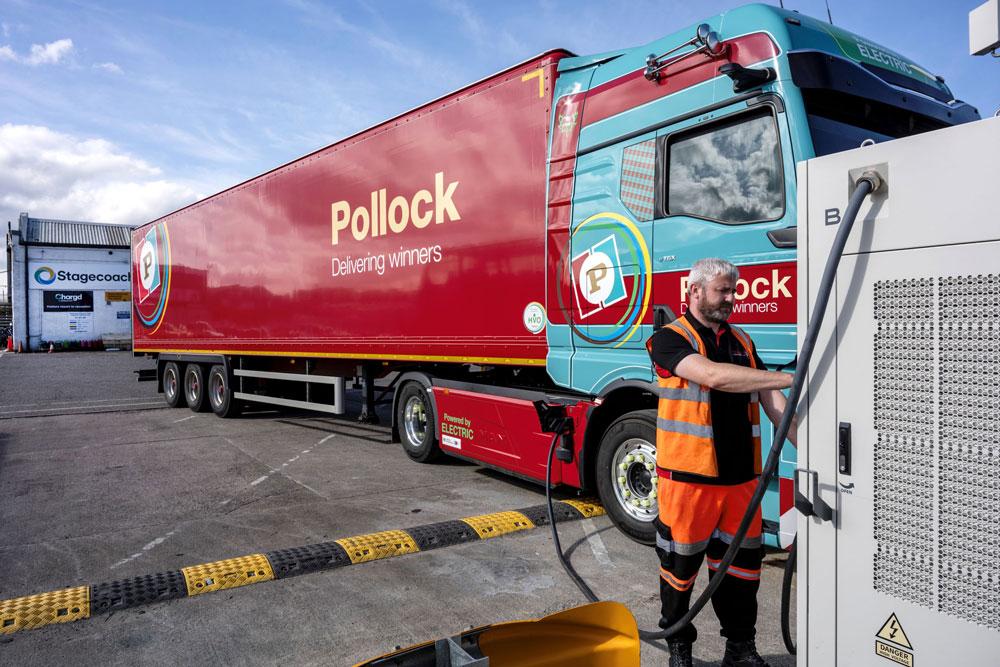
Over its lifetime, eFREIGHT 2030 will deploy 100 electric HGV tractor units alongside a national network of 35 eHGV charging sites, including 25 megawatt-scale charging hubs designed specifically for heavy vehicles. But the numbers only tell part of the story. What matters more is how those vehicles and chargers are being used.
From first deliveries to industry milestones
One of the earliest milestones came in late 2024 when the first eFREIGHT 2030 eHGV, also the UK’s first 42-tonne Renault Trucks E-Tech, entered service with Welch’s Transport. It was immediately deployed on live operations from their Cambridgeshire flagship site, handling both regional distribution and long-haul deliveries.
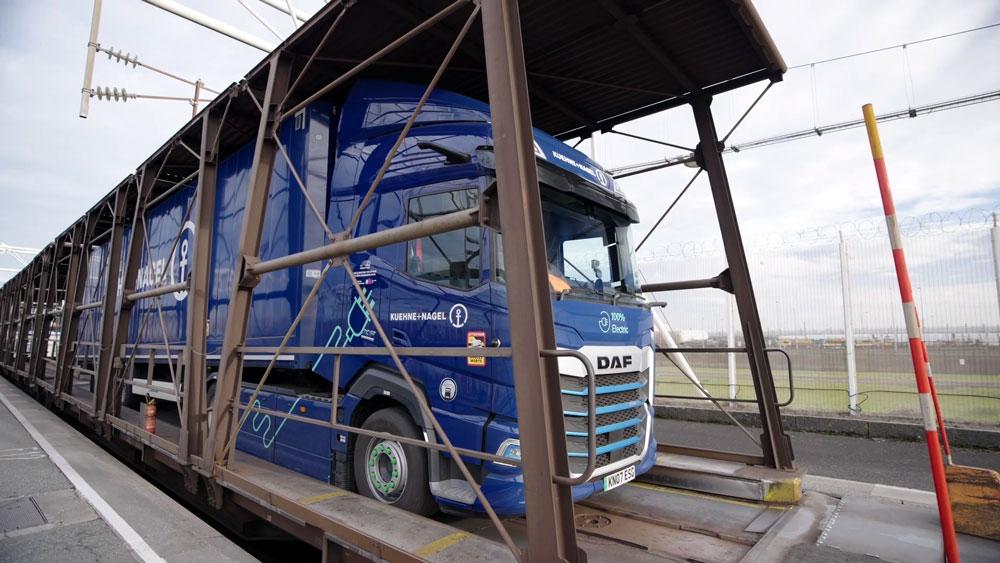
The most recent milestone saw the first battery-electric HGV to complete a commercial freight journey through the Channel Tunnel, moving freight between the UK and mainland Europe. Bringing together three eFREIGHT 2030 consortium members, Kuehne+Nagel’s DAF New Generation XF started its journey at its East Midlands Gateway depot with the trailer fully loaded, and a full charge using the Voltempo HyperCharger on its 1700km round trip to Haiger in Germany.
What makes this significant isn’t the distance. It’s the operational reality – the vehicle ran to real logistics schedules, managed charging stops, and handled multi-country freight flows just like a diesel truck would. For an industry built on reliability and predictability, it proves a crucial point – electric HGVs are now capable of long-haul, cross-border operations, showing sustainable freight can be practical, efficient, and ready to scale.
For fleet operators watching from the sidelines, these early demonstrations are shifting perceptions. The question is no longer if electric freight can work, but where and how quickly it can be deployed.
Charging designed around freight operations
If vehicles are the visible part of the transition, charging infrastructure is the foundation. One lesson has become increasingly clear through eFREIGHT 2030: freight charging cannot simply borrow models designed for passenger cars.
HGV operations are planned, repeatable and time-critical. Vehicles return to base, dwell for defined periods, and energy demand is predictable. That makes depot-based charging not just logical, but essential.
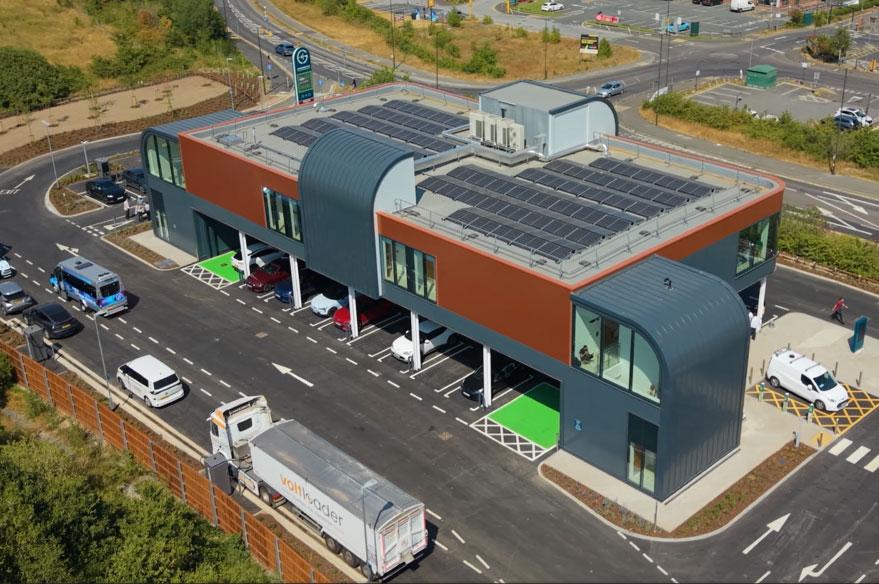
In January, and marking another milestone, the eFREIGHT 2030 consortium opened the UK’s first megawatt-scale eHGV charging site, using Voltempo’s HyperCharger technology at East Midlands Gateway to support Kuehne+Nagel’s UK road operations.
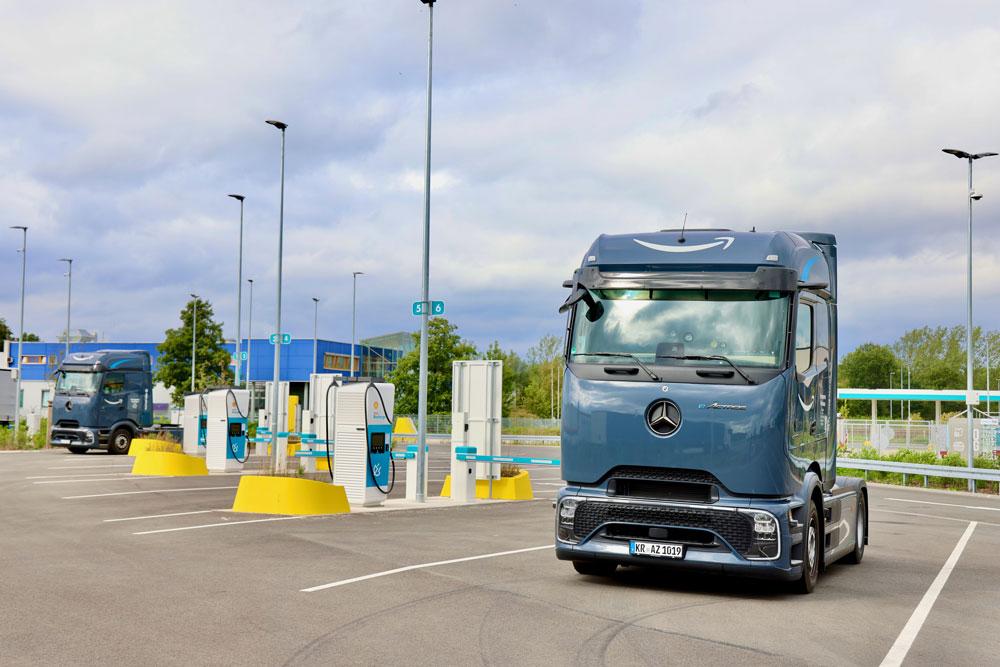
Built for heavy-duty freight, the six-bay hub delivers up to 1MW of capacity, dynamically shared across multiple vehicles, enabling rapid turnaround for electric trucks covering longer distances and heavier duty cycles. The site’s commissioning demonstrated how depot-based infrastructure, strategically placed in key logistics hubs, gives operators confidence to electrify without sacrificing utilisation or reliability.
For fleets transitioning from diesel, it marks a practical shift from speculative planning to real-world charging capability, turning what was once a barrier into a foundation for growth. E
F This hub is the first of many. Over the programme’s course, eFREIGHT 2030 will establish more than 35 high-power charging locations at depots and logistics hubs across the UK, forming a shared, depot-anchored network supporting participating fleets and, where capacity allows, other operators running electric vans or trucks.
Why depots are the backbone of electric freight
Public charging will always play a role in the wider EV ecosystem. But for freight, depots sit at the heart of daily operation – which is why eFREIGHT 2030 is rolling out the UK’s largest depot-based eHGV infrastructure network.
At depots, fleets can prioritise their own vehicles, control third-party access, and align energy use with operational needs. High utilisation improves the business case. Predictable demand supports smarter grid planning. And because depots typically sit in established logistics corridors, they’re well-placed to offer supplementary charging to nearby fleets under pre-agreed arrangements.
This “Depot Point Operator” (DPO) model complements rather than replaces public charging. Within eFREIGHT 2030, it’s proving one of the most effective ways to accelerate adoption while keeping costs and complexity in check.
Data-driven planning builds confidence
Planning has been as critical to eFREIGHT 2030 as deploying vehicles and infrastructure. Consortium partner Dynamon provides fleets with detailed modelling and decision support through its ZERO software platform, enabling operators to match emerging electric HGV technologies to real operational requirements.
By analysing routes, duty cycles, payloads, energy demand and charging windows in advance, fleets can optimise how diesel and electric vehicles work side by side, assess total cost of ownership, and pinpoint exactly which vehicles and routes are ready for decarbonisation now, and which will follow as capability grows. This data-led approach gives operators the confidence to electrify with intent, replacing assumption and trial-and-error with informed, commercially grounded decisions.
For many fleets, this has been a turning point. Electrification stops being an abstract sustainability goal and becomes a measurable operational decision and one assessed against total cost of ownership, service levels and long-term strategy.
Early results, real learning
Some of the most valuable insights from eFREIGHT 2030 have come from drivers, depot managers and planners integrating electric HGVs into daily operations. Fleets running electric trucks on regular delivery routes report smoother vehicle handling, lower noise levels and a more comfortable driving experience. These factors matter as they play a direct role in driver acceptance, retention and satisfaction, all increasingly critical as the sector navigates decarbonisation.
Just as importantly, the programme has highlighted where challenges remain, from grid connection timelines to the need for continued standardisation in high-power charging. Learning what doesn’t work is as important as celebrating what does.
eFREIGHT 2030 has shown that deploying high-power charging for electric HGVs is about more than installing chargers – it’s about navigating network capacity, site complexity and differing processes across Britain’s six DNOs. While some connections have been straightforward, others have required work to streamline processes and ensure the network supports wider adoption.
These lessons are shaping long-term strategies, reinforcing the importance of DNO collaboration and strategic planning to enable fleets to decarbonise at pace while supporting operational efficiency and the UK’s net-zero ambitions.
What comes next
eFREIGHT 2030 is now firmly in demonstration phase. Vehicles are in service, charging hubs
are live, data is flowing, and interest from fleets beyond the consortium continues
to grow.
The next stage is about scale. The five-year demonstration phase is focused on gathering real-world operational data connecting depots, extending routes and into more challenging use cases that will give more operators the confidence to electrify more of their fleets more quickly.
Achieving that will depend on continued collaboration across industry and government, supported by pragmatic policy that reflects the realities of freight operations. Progress to date has been significant, and technology continues to move forward at pace. The task now is to turn that momentum into sustained delivery, using evidence from live operations to accelerate the adoption of electric HGVs at scale and make them the natural choice for the future.
The prize is significant. For operators, electrification offers potential for lower operating costs over time, greater energy certainty and new revenue opportunities through shared infrastructure. For the sector, it represents a credible route to reducing emissions from one of the hardest-to-abate parts of the transport system.
Road freight plays a critical role in the UK economy, but it’s also a major carbon contributor. Decarbonising it is essential if national climate targets are to be met. By proving that zero-emission HGVs can work in real-world operations – at depots, on strategic routes and across borders – eFREIGHT 2030 is helping turn climate ambition into practical action, delivering quieter depots, cleaner air, and a freight system fit for a net-zero future.