As fleet operators electrify, constrained grid connections and rising energy costs are creating new challenges. Cenex’s Greg Payne explores how integrated DC energy hubs combining solar, battery storage, smart controls and bidirectional charging could help fleets reduce energy costs and maximise existing infrastructure
As fleet operators accelerate the transition to electric vehicles, one challenge consistently rises to the top of the agenda: energy. While vehicle technology continues to advance, many depots, workplaces and operational sites face a more immediate constraint – the electricity network connection available to support charging.
For many organisations, installing multiple chargers can trigger costly grid upgrades, long lead times and increased energy bills. The question is no longer simply how to electrify vehicles, but how to do so efficiently and economically.
Recent modelling undertaken by Cenex as part of the Innovate UK-funded 3ti V2X DC FastHub Demonstration Project suggests that integrated energy hubs could offer a compelling answer. By combining solar generation, battery storage, smart controls and bidirectional charging within a single DC microgrid, these systems have the potential to reduce energy costs, lower peak demand and enable EV charging without major infrastructure upgrades or long lead times.
Moving beyond traditional charging
Most EV charging installations are designed around one primary task: charging vehicles. However, a modern fleet energy system can perform a much broader role.
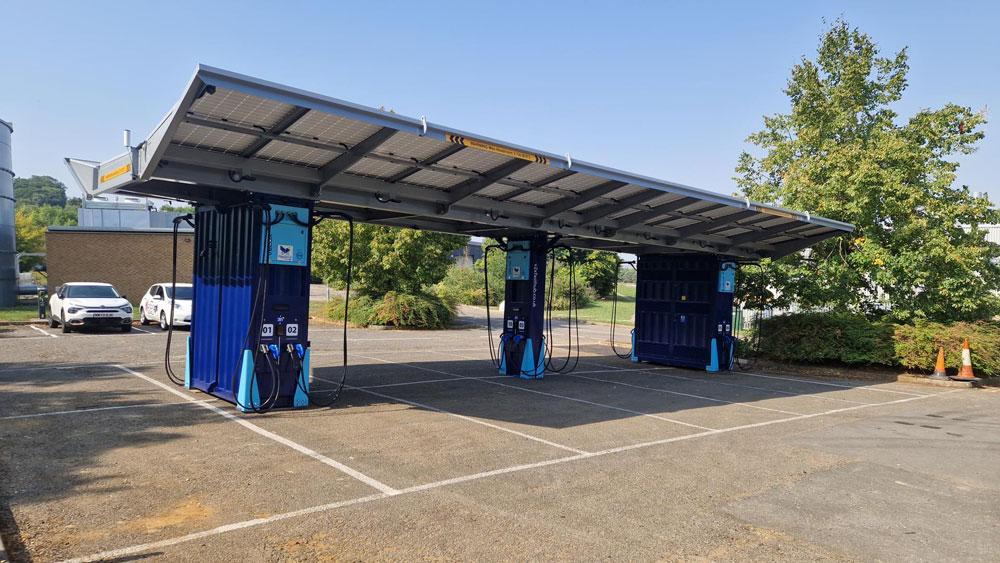
The 3ti Papilio3 FastHub evaluated in the project combines 12 bidirectional 30kW chargers, a 280kWh battery energy storage system (BESS), 20 kWp solar PV generation and a single grid connection within a containerised, rapidly deployable solution.
What makes the approach particularly interesting is its DC architecture. Instead of converting electricity between alternating current (AC) and direct current (DC) multiple times as energy moves between solar panels, batteries and vehicles, all major components operate within the same DC system. This reduces energy losses and allows smarter management of on-site energy resources.
For fleet operators, the practical outcome is simple: the ability to make better use of available electricity while reducing dependence on expensive grid upgrades.
Why fleets are an ideal candidate
The modelling work examined four representative site types: fleet depots, factories, offices, and golf clubs and destination venues.
Although these environments differ significantly, they share a common characteristic: electricity demand (whether from the building or EV charging) fluctuates throughout the day.
This creates opportunities to shift this energy consumption away from expensive periods and make better use of locally generated renewable power.
At sites where vehicles remain plugged in for extended periods, bidirectional charging also opens the possibility of using vehicle batteries to support wider site energy demand.
Turning EVs into energy assets
One of the most significant findings from the study is the value of intelligent energy management.
Rather than charging vehicles as soon as they are plugged in, the FastHub model optimises charging and discharging based on electricity tariffs, solar generation, battery state of charge and site demand.
A typical operating strategy might look like this: the battery energy storage system recharges overnight when electricity is cheapest, while solar generation supports daytime vehicle charging. Battery storage helps reduce afternoon demand peaks, charging is rescheduled to lower-cost times wherever possible, and V2G enabled vehicles and batteries discharge during expensive tariff periods.
The result is lower energy costs and more efficient use of available infrastructure.
Importantly, the system is designed to work behind the meter, meaning it supports site energy optimisation without requiring significant intervention from the wider electricity network.
Significant savings across multiple site types
The modelling demonstrated recurring cost reductions across all site archetypes evaluated.
Using a conventional two-rate electricity tariff, annual energy cost savings included approximately £3,200 per year for the fleet depot, approximately £2,600 per year for the office, approximately £3,700 per year for the golf club, and approximately £18,200 per year for the factory.
The factory site delivered by far the greatest benefit because of its substantial electricity demand and the opportunity to shift large amounts of energy consumption away from peak-price periods.
While these figures relate only to electricity costs and do not include capital or operational expenditure considerations, they illustrate the scale of savings available through intelligent energy management.
The findings also highlight an important lesson for fleet operators: the value of energy optimisation increases as overall site electricity demand grows.
Dynamic tariffs unlock even greater value
Perhaps the most eye-catching results emerged when the model was tested against dynamic electricity tariffs.
Unlike traditional day and night tariffs, dynamic tariffs change frequently, reflecting wholesale electricity prices throughout
the day.
The flexibility built into the FastHub proved particularly effective in responding to these price signals.
Under dynamic tariff conditions, annual savings increased dramatically: over £13,000 for the fleet depot, over £13,000 for the office, nearly £14,000 for the golf club, and more than £90,000 for the factory.
These figures demonstrate how energy flexibility could become increasingly valuable as electricity markets evolve.
However, the report also notes an important consideration. Achieving the highest savings often requires more intensive use of vehicle batteries through bidirectional charging.
Fleet operators will therefore need to balance financial benefits against battery usage and long-term asset management strategies.
Tackling one of electrification’s biggest barriers
Beyond reducing energy costs, the study highlights another major benefit: avoiding or postponing grid upgrades.
Many fleet sites face limitations in available connection capacity. Traditionally, adding multiple chargers requires increasing site capacity agreements or waiting for network reinforcement works.
The FastHub approach uses battery storage and intelligent control to work within existing constraints. In fact, for three out of the four sites assessed, we found that by adding the FastHub the grid import capacity could be reduced whilst accommodating the extra demand for EV charging. This demonstrates how energy hubs can effectively distribute and manage power across multiple vehicles without demanding large increases in connection capacity.
For fleet operators struggling with constrained grid connections, this capability could significantly accelerate electrification plans.
Efficiency matters too
Although cost savings and grid constraints often dominate discussions around fleet charging, energy efficiency also plays an important role.
The modelling compared the DC microgrid approach with a more conventional arrangement consisting of separate solar, battery and charging systems. Because the FastHub minimises repeated AC-to-DC and DC-to-AC conversions, it reduces energy losses.
At the factory site, avoided conversion losses equated to savings ranging from around £300 per year under simple operation to more than £2,100 annually when advanced energy optimisation strategies were applied.
While relatively small compared with tariff savings, these efficiencies contribute additional value and support wider sustainability objectives.
A new approach to fleet energy
The transition to electric fleets has often been discussed as a vehicle challenge, but increasingly it is becoming an energy management challenge.
The Cenex modelling demonstrates that integrated energy hubs have the potential to address several of the biggest barriers fleets face today: constrained grid connections, rising energy costs and the need to maximise infrastructure utilisation.
By combining solar generation, battery storage, bidirectional charging and intelligent controls within a single deployable system, organisations can transform EV charging from a new source of demand into an active energy management tool.
For fleet operators planning the next stage of electrification, the message is clear. The future is not just about where vehicles charge. It is about how energy is generated, stored, managed and shared across the entire site ecosystem. Those organisations that optimise all four may unlock far greater value than charging alone can ever deliver.
Get in touch with Cenex for advice with your fleet and site electrification and support with modelling your energy optimisation strategies.