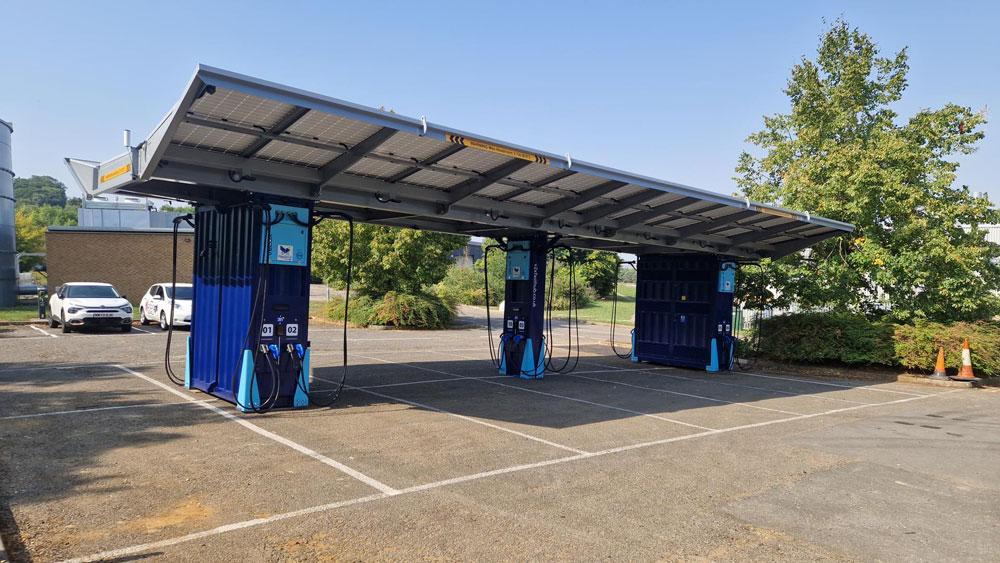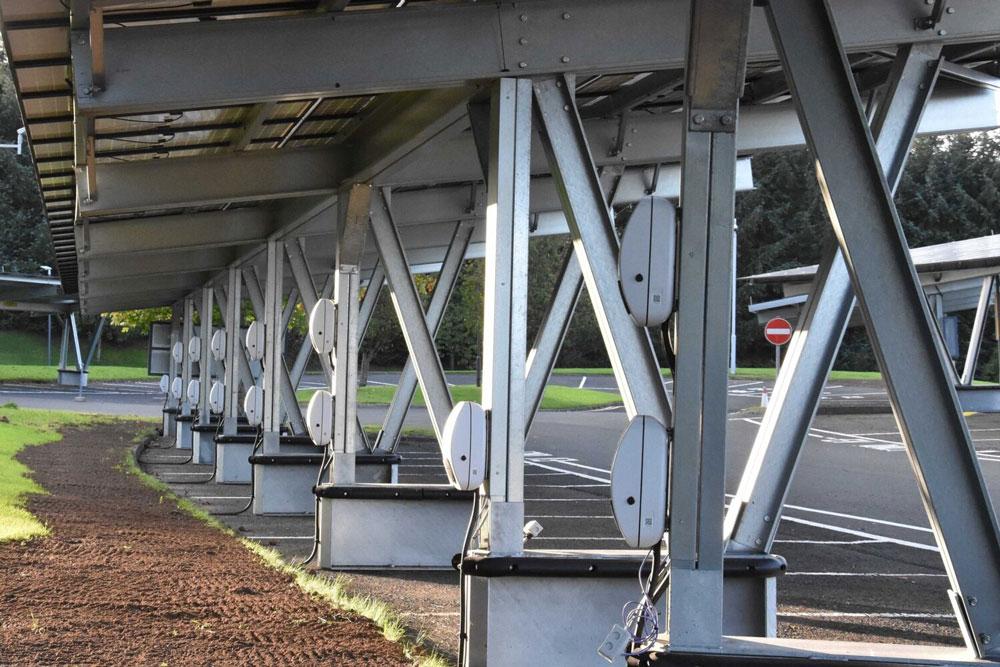
Solar carports are becoming an increasingly attractive solution for fleet operators, offering a way to lower EV charging costs, improve energy security and make better use of existing estate space
With electricity prices remaining volatile, solar carports have emerged as a strategic solution to give organisations improved energy predictability and greater protection against rising utility prices – all while making better use of existing estate space.
Solar carports do this by transforming underused parking areas into energy-generating assets. Installed above parking bays, the canopies are fitted with photovoltaic (PV) panels that generate electricity on site, reducing reliance on the grid.
When integrated with EV charging infrastructure and battery storage, the electricity generated can power electric vehicles directly, making solar carports a great strategic asset for fleet operators.
Government momentum behind solar
Solar carports are already mandatory in some European countries, including France and Slovenia, providing their countries with an abundance of cheaper solar power.
In the UK, interest in solar infrastructure grew at policy level last year, when the government launched a consultation which explored the possibility of mandating solar installations on new outdoor car parks for public and private organisations, alongside reforms on EV charging deployment.
However, while giving a detailed response to the EV charging infrastructure section, the government has said that proposals to mandate solar canopies on new outdoor car parks will not be taken any further.
That said, government clearly still has great interest in solar. The UK’s Clean Power 2030 Action Plan targets a major expansion in solar capacity, with ambitions to increase deployment from around 18GW today to at least 45-47GW by the end of the decade.
The business case
With or without a mandate, the business case of solar carports is becoming increasingly compelling for organisations.
Industry estimates suggest that an 80-space solar car park can save approximately £28,000 annually when
the electricity generated is consumed entirely on site.
Companies could also make back the cost of installing solar in carparks by selling energy back to the grid or through long-term power purchase agreements.
Battery storage in particular is a critical component to making the most of a solar carport. By storing excess solar generation during the day and discharging it during peak charging periods, battery storage can help smooth demand, reduce peak charges and provide greater operational certainty for high-usage EV fleets.
Solar canopies also have the benefit of providing shaded cover for cars during heatwaves, creating a cooler environment for both vehicles and pedestrians.
Examples of solar carports
Across the UK and Ireland, many organisations are already demonstrating how solar carports can support large-scale operational energy strategies, as well as the electric vehicle transition.
Northumberland County Council has a major solar carport installation at its County Hall headquarters in Morpeth. Delivered by UK Power Networks Services, the project combines an 800kW solar canopy, a 400kW battery storage system and 120 EV charge points to provide renewable energy for the council’s buildings and vehicle fleet.
Councillor Glen Sanderson, council leader and cabinet member for climate change, said that the project will save a “massive amount on council energy supply spending” and will also reduce the need for the council to rely on fossil fuels to power its main building.
Aviva meanwhile has installed a massive solar carport consisting of 3,283 solar panels at its Perth office in Scotland. The system features 50 smart chargers linked to central smart hubs, allowing them to safely distribute power and charge 50 electric fleet and commuter vehicles simultaneously using clean energy.
In the healthcare sector, Eastbourne District General Hospital has an installation which spans more than 2,400 solar panels across 400 parking bays. The system is expected to generate around 1,000MWh of electricity annually while powering ten EV chargers and reducing carbon emissions by 222 tonnes each year.
At Scunthorpe Hospital, meanwhile, a £27 million decarbonisation programme includes replacing an existing staff car park with a solar canopy installation designed to help cut emissions by more than 4,000 tonnes annually.
Education providers are also recognising the value of integrated solar infrastructure. Mid Kent College has incorporated solar carports into a wider campus decarbonisation programme that combines rooftop solar, battery storage and solar façades. The project is expected to generate more than 310,000kWh annually while also serving as a live educational resource for students studying sustainable technologies.
Reducing grid dependence
At Legoland Windsor Resort, a 1.2MW solar PV carport installation has been installed, which is capable of generating more than 1.1 million kWh of electricity annually. The system now supplies renewable energy across the resort, reducing grid dependence and improving long-term energy resilience.
Cork Airport recently announced plans to develop what is expected to become the Republic of Ireland’s largest solar-powered carport. Having secured €2 million in government support, the 1.7MW installation will consist of nearly 3,700 solar panels mounted above the existing Holiday Blue car park. Once complete, the project is expected to generate approximately 1.5GWh annually – enough to supply around 20 per cent of the airport’s electricity demand.
St Ives Park & Ride Smart Energy Grid project in Cambridgeshire combines a 1MWp solar canopy with EV charging bays, battery storage and advanced digital energy controls. The advanced grid controls and energy management system enable efficient balancing of energy production and consumption on-site, while providing flexibility to the local grid.
A strategic asset for companies
For fleet operators, solar carports are becoming a strategic asset, particularly in the context of EV adoption. Co-locating solar generation with charging infrastructure not only reduces electricity costs but also improves energy security and reduced exposure to future grid pressures.