Using electric HGVs is a big operational shift that requires confidence both in the vehicles and in the charging infrastructure. Sam Clarke, head of eHGV at GRIDSERVE, explores how the Electric Freightway project is tackling these challenges to make zero-emission haulage a reality
Freight’s importance to the UK economy is matched only by its environmental impact. Heavy goods vehicles represent a relatively small proportion of vehicles on the road, yet they account for close to a fifth of domestic transport CO2 emissions.
At the same time, regulatory pressure is intensifying. The UK Government is preparing to phase out the sale of new non-zero emission HGVs up to 26 tonnes by 2035, and all new non-zero emission HGVs by 2040, while similar pressures are playing out across Europe.
Against this backdrop, the question is no longer whether the sector will electrify, but how quickly it can do so without compromising operational performance.
For fleet managers responsible for keeping goods moving, the barriers to electrification are real and rooted in the practical realities of vehicle range, charging access, route planning and the cost implications of making that technology change. This is a big operational shift that requires confidence both in the vehicles and in the charging infrastructure.
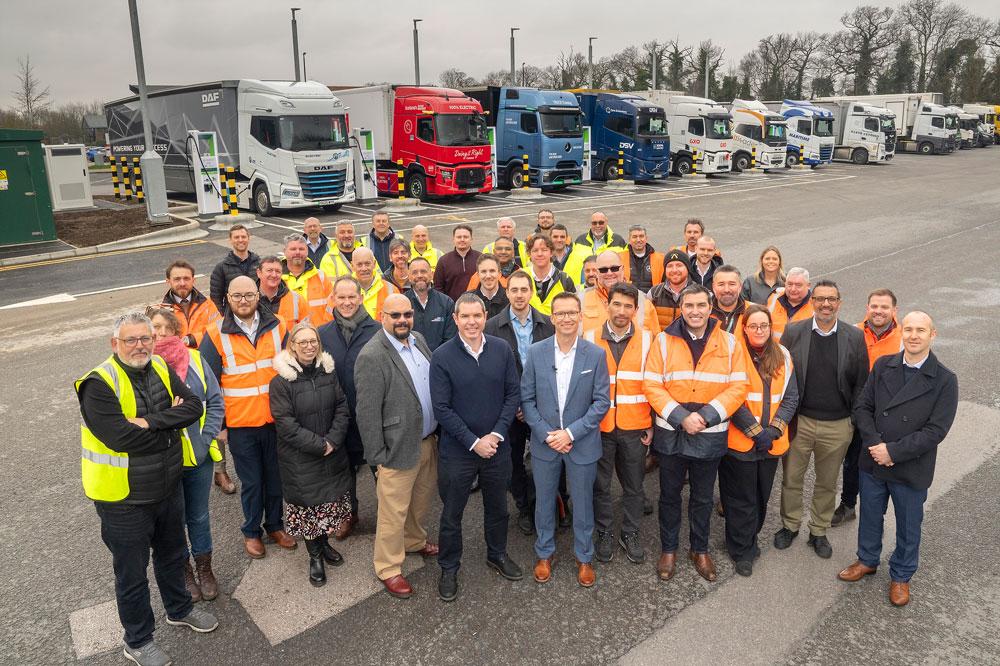
The Electric Freightway was created to address those two major concerns. Funded through the Department for Transport’s Zero Emission HGV and Infrastructure Demonstrator (ZEHID) programme and delivered in partnership with Innovate UK, it brings together more than 25 consortium partners, including hauliers, manufacturers and infrastructure specialists to showcase a cleaner way forward for freight.
That dual focus is already producing tangible results. Electric HGV (eHGV) uptake, while still small in absolute terms, is accelerating rapidly. The UK surpassed a symbolic milestone of 1,000 eHGVs registered last year, while registrations rose by 171 per cent year-on-year, with more than a quarter of those vehicles coming directly through the Electric Freightway programme.
Electric HGVs in action
Crucially, those vehicles are not sitting idle. Participating fleets, from Amazon to Iceland, have already recorded more than half a million zero-emission miles, providing a growing body of real-world data on performance, energy use and cost that was previously lacking and that hauliers can review.
Early analysis conducted by Hitachi ZeroCarbon also suggests that, under certain conditions - particularly high-mileage operations - cost parity between diesel and electric HGVs can be achieved within five years, while lifetime emissions from diesel vehicles can be up to three times higher than their electric counterparts. And as eHGV volumes increase and battery technology continues to improve, those cost of ownership calculations will continue to become more favourable and compress the timelines to cost parity.
Yet without reliable, accessible charging, even the most capable vehicles cannot be deployed effectively. This is where GRIDSERVE comes in. In the space of five years, we have created the UK’s most used public charging network for passenger cars and vans by focusing on the fastest and most reliable chargers in the most convenient locations. Although the infrastructure is bigger, more expensive and more complex, the Electric Freightway is committed to doing exactly the same for
electric trucks.
Depot charging infrastructure is a great starting point for fleets and a standout example has been the 10-bay shared charging facility we delivered at Nissan’s Sunderland plant. It has helped to decarbonise an entire supply chain and illustrates how electric trucks can be integrated into demanding logistics environments when charging is planned and scaled appropriately.
But working with the consortium, we’re also designing a public eHGV charging network that goes beyond the depot, focusing on motorway-based locations that can be both technically capable and operationally relevant.
Public HGV charging facilities
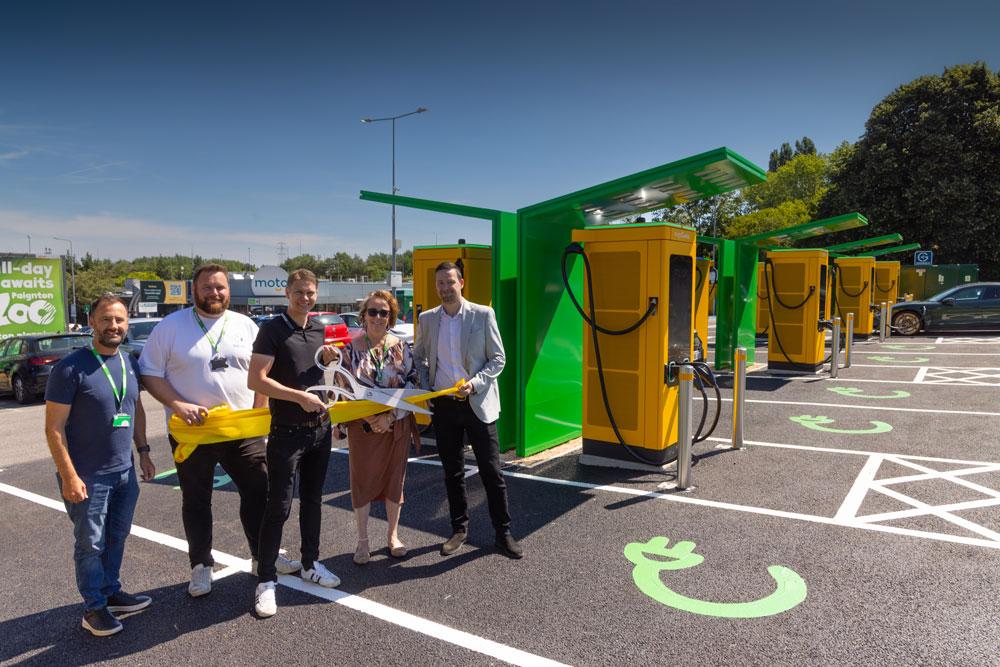
The first visible manifestation of that strategy came with the opening of the UK’s first public eHGV charging stations at Extra Baldock on the A1(M) and Moto Exeter on the M5 earlier this year. Both sites marked a defining moment and reflect a level of operational detail that fleet managers will recognise immediately. Baldock launched with six dedicated charging bays, while Exeter opened with four, each incorporating safety features such as wide walkways, lighting, sensors and CCTV to support driver movement around large vehicles.
In practical terms, these locations show that electric trucks can complete real routes, charge during mandated breaks and return to service without disruption. A DAF XF Electric, International Truck of the Year 2026, recently reinforced that point, completing a journey between the two hubs to illustrate how strategic infrastructure will enable long-distance zero-emission
haulage.
Momentum has continued to build since those first openings. As of March, four additional public eHGV charging hubs have been confirmed at Moto Knutsford North, Moto Medway East, Markham Vale Electric Forecourt and Stevenage Electric Forecourt. These locations will join the five eHGV hubs already under construction at Tamworth, Thurrock, Leeds, Chester and Strensham North, bringing the total pipeline to eleven locations.
Challenges to overcome
Of course, these sites are not without their ongoing challenges, particularly around grid connection timelines and energy capacity charges, both of which need to be urgently addressed by government. Infrastructure must continue to expand, vehicle supply must scale, and the energy system must adapt to support increased demand. But the trajectory is now established and as Daniel Kunkel, CEO of GRIDSERVE, has put it, zero-emission freight is no longer a future ambition, but a live, operational reality. The entire conversation has shifted from whether electrification is feasible towards how it can be implemented most quickly and effectively.
For fleet managers across both public and private sectors, there is now a clear choice. Those who engage early - testing vehicles, understanding infrastructure and adapting operations - will be best placed to navigate the transition. Those who wait may find that the pace of change, driven by regulation, economics and customer expectations, leaves little room to catch up.
What the Electric Freightway ultimately aims to achieve is not just provide a network of ultra-rapid chargers, but to help shift the UK mindset. By aligning infrastructure, vehicles and real-world operations, it is turning the electrification of freight from a strategic aspiration into a practical pathway. And for an industry built on reliability and efficiency, that may be the most important development of all.